

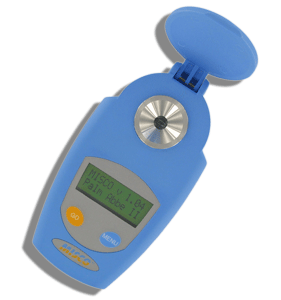
Palm Abbe Refractometer for Water Analysis: Salinity – Extended
6.851 SEK
The Palm Abbe AQAUR H50 measures seawater salinity in kg/cubic meter (PSU), Sigma-t density, density, conductivity, and chlorine content.
Volume discount: 5 pcs: 2% · 10 pcs: 3% · 25 pcs: 5%
- Free shipping on orders over 3000 kr excl. VAT
- Refractometers from Misco, Atago and Extech
- Call us +46 8 753 00 04
Description
52-PA-H50
52-PA-H50
Laboratory precision in your hand!
The Palm Abbe AQUAR ™ Digital seawater refractometer is equally at home on
board or on land, and is specifically designed for oceanography,
aquaculture, professional aquariums, desalination plants, and marine research.
This refractometer overcomes many of the limitations of
other testing methods, including chloride titration, specific gravity using
hydrometers, and conductivity measurements, for testing seawater,
brine, and brackish water.
The AQUAR series refractometers are based on the accepted physical
properties of seawater and the latest research, as
published by the United Nations Educational, Scientific and Cultural Organization (UNESCO) and others.
It is this seawater research that distinguishes the Palm Abbe AQUAR refractometer from other refractometers that are based solely on
sodium chloride and water. Although sodium chloride is one of the most important
components in seawater, there are sufficiently many other
components that make a standard sodium chloride refractometer inaccurate with
regard to the physical properties of seawater. Other refractometers that
claim to be seawater refractometers are likely based on
outdated data and display results in ppt instead of the approved ”Practical Salinity Units”.
Traditional analog refractometers are not even automatically
temperature-compensated, which means that the measurement can vary significantly
for every degree Celsius the instrument’s
temperature deviates from 20 °C (68 °F). Even measurements on analog
refractometers are subjective and they are difficult to read on a boat
rocking on the water.
Specification
52-PA-H50
52-PA-H50
Laboratory precision in your hand!
The Palm Abbe AQUAR ™ Digital seawater refractometer is equally at home on
board or on land, and is specifically designed for oceanography,
aquaculture, professional aquariums, desalination plants, and marine research.
This refractometer overcomes many of the limitations of
other testing methods, including chloride titration, specific gravity using
hydrometers, and conductivity measurements, for testing seawater,
brine, and brackish water.
The AQUAR series refractometers are based on the accepted physical
properties of seawater and the latest research, as
published by the United Nations Educational, Scientific and Cultural Organization (UNESCO) and others.
It is this seawater research that distinguishes the Palm Abbe AQUAR refractometer from other refractometers that are based solely on
sodium chloride and water. Although sodium chloride is one of the most important
components in seawater, there are sufficiently many other
components that make a standard sodium chloride refractometer inaccurate with
regard to the physical properties of seawater. Other refractometers that
claim to be seawater refractometers are likely based on
outdated data and display results in ppt instead of the approved ”Practical Salinity Units”.
Traditional analog refractometers are not even automatically
temperature-compensated, which means that the measurement can vary significantly
for every degree Celsius the instrument’s
temperature deviates from 20 °C (68 °F). Even measurements on analog
refractometers are subjective and they are difficult to read on a boat
rocking on the water.

There are no reviews yet.